
Búðakirkja Church
Búðakirkja, the Black Church of Búðir, is a small black timber church standing alone on the edge of the Búðahraun lava field on the southern coast of the Snæfellsnes Peninsula, with the Snæfellsjökull glacier visible behind it on clear days. It is one of the most photographed churches in Iceland and a popular wedding venue. Originally built in 1703 by the merchant Bendt Lauridsen, it fell into disrepair when the trading settlement of Búðir declined, was deconsecrated in 1816, and lay abandoned until a local merchant's widow, Steinunn Sveinsdóttir, campaigned persistently for its reconstruction against opposition from the national church authorities. The rebuilt church was completed in 1848. The door ring bears the inscription: "The church was rebuilt in 1848, with no support from the spiritual leaders." Steinunn is buried in the churchyard beside it.
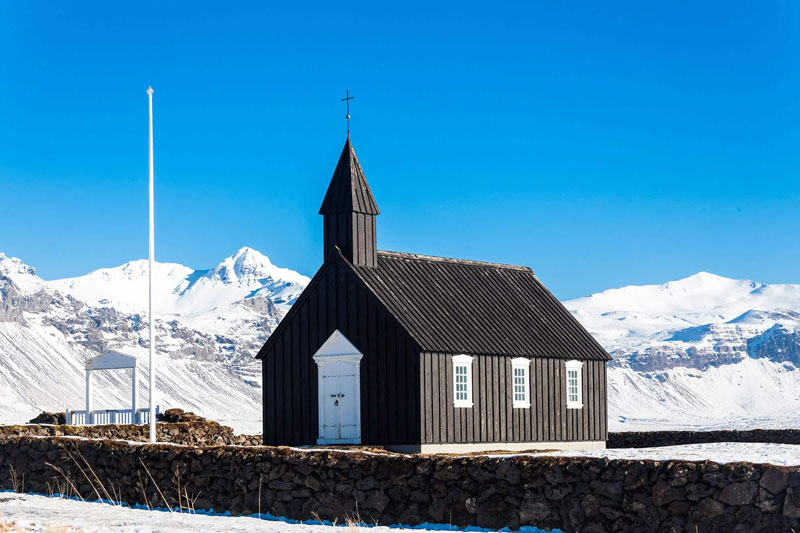
A Black Church Rebuilt Against the Church's Wishes in 1848, Its Door Inscription Still Recording the Defiance
The first church at Búðir was built in 1703 by the Danish merchant Bendt Lauridsen as part of the trading settlement that made Búðir one of the busiest ports on the Snæfellsnes Peninsula at the time. When the trading settlement declined in the early 19th century, the church fell into disrepair alongside it and was formally deconsecrated in 1816. The community around Búðir wished to see it rebuilt, but the national church hierarchy was unwilling to support the project financially or institutionally. A local widow, Steinunn Sveinsdóttir, took it upon herself to campaign for reconstruction, persuading enough support that the church authorities agreed on the condition that the local community finance and maintain the building entirely at their own expense. The rebuilt church was consecrated in 1848. To mark the circumstances of its reconstruction, the door ring was inscribed: "The church was rebuilt in 1848, with no support from the spiritual leaders." The inscription remains on the door today. Steinunn died before the church's centenary and is buried in the churchyard immediately beside the building she fought to restore.
The church was restored again in 1987 with assistance from the National Museum of Iceland, and the current building, painted black in the traditional Icelandic church style, sits precisely where its predecessors stood. It is an active parish church with around 120 registered parishioners and is used for weddings, christenings, and periodic summer concerts. The interior is small and plain, with white painted walls and simple wooden fittings, and a few original items from earlier versions of the church survive, including the lock on the entrance gate. The church's setting gives it its visual power: the dark timber against the ancient black lava field, with the white cone of Snæfellsjökull rising in the background on clear days, is the composition that has made it one of the most reproduced images of Iceland in any medium.
Búðakirkja is on Route 574 on the southern Snæfellsnes coast, about 175 kilometres from Reykjavík and two and a half hours by car. The car park serves both the church and the nearby Hótel Búðir. The church and lava field are free to visit and accessible year-round, though summer evening light gives the building its most dramatic appearance. It is often visited together with the Búðahraun lava field walk and the nearby Ytri Tunga seal beach to the east. The church is usually open during daylight hours but may close for private events; note that wedding bookings are common in summer and the site can be briefly inaccessible.


